
SpaceX Makes History as Starship Is Caught Mid-Air by Giant Mechanical Arms in Texas
The successful recovery of Starship's upper stage during Flight 15 marks a major breakthrough in reusable rocket technology, bringing Elon Musk's vision of faster and more affordable space transportation closer to reality.
By HarisTimes
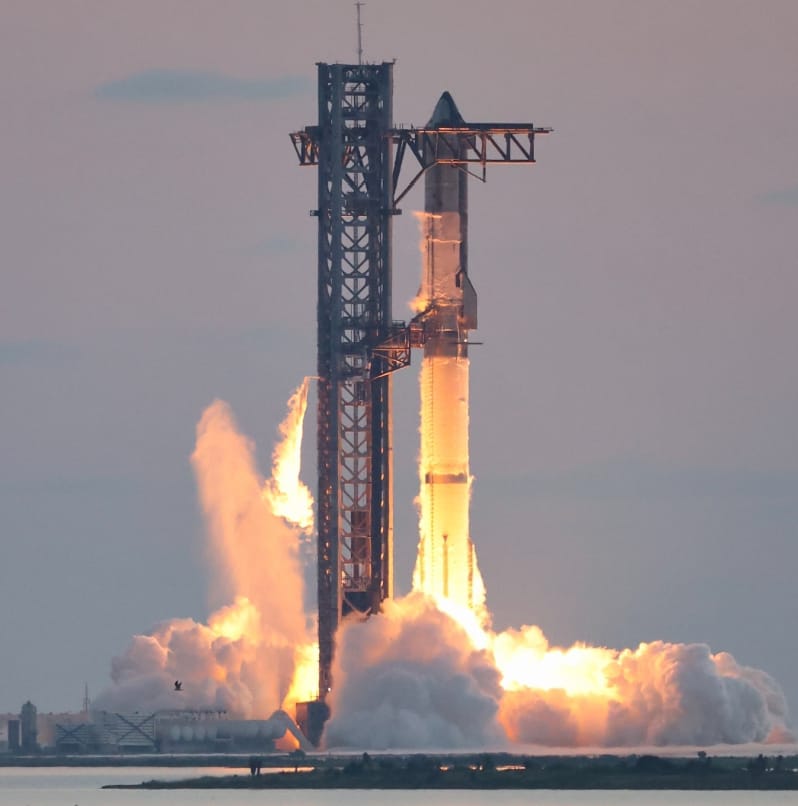
SpaceX has achieved another remarkable milestone in space exploration after successfully catching its massive Starship spacecraft in mid-air using giant mechanical arms attached to its launch tower in Texas. The historic achievement marks the first successful capture of the Starship upper stage following its return from space, demonstrating a major advancement in the company's ambitious reusable rocket programme.
The operation took place on November 14, 2026, at SpaceX's Starbase facility in South Texas during the company's 15th Starship test flight. After spending approximately 22.5 hours in space, the spacecraft returned through Earth's atmosphere, descended towards its launch facility and was carefully caught by two enormous mechanical arms known as the "chopsticks."
The dramatic moment was celebrated by SpaceX employees and space enthusiasts watching the operation. Company founder Elon Musk congratulated the engineering team, describing the achievement as an important step forward for the Starship programme.
A Historic Moment for SpaceX
The successful capture represents a significant development in SpaceX's efforts to make its rockets fully reusable.
Unlike traditional rockets, which generally discard major sections after launch, SpaceX is developing a system designed to recover and reuse both stages of its Starship launch vehicle.
The giant mechanical arms are part of a launch tower system nicknamed Mechazilla. They are designed to catch returning rocket stages and position them for inspection, maintenance and eventual reuse.
SpaceX had previously demonstrated successful catches of its Super Heavy booster. However, catching the Starship upper stage was a different and considerably more challenging objective because the spacecraft travels farther and returns at higher speeds.
The November 14 operation marked the first time the company successfully completed this particular recovery manoeuvre.
How the Chopsticks Catch Works
The recovery system relies on precise coordination between the spacecraft, its engines, navigation systems and the launch tower.
After completing its mission in space, Starship begins its journey back towards Earth. During atmospheric re-entry, the spacecraft experiences extreme temperatures and aerodynamic pressure.
As it approaches the designated landing area, it performs a controlled manoeuvre to position itself vertically. Its Raptor engines then restart to slow its descent and guide it towards the launch tower.
At the final moment, the tower's mechanical arms move into position and carefully secure the descending vehicle.
The process requires extremely accurate calculations, timing and communication between multiple systems. Even a small navigation or positioning error could prevent a successful capture.
The latest achievement demonstrates that SpaceX has made substantial progress in managing this complicated recovery sequence.
Super Heavy Booster Recovery Faces a Setback
Although the Starship spacecraft completed its historic landing, the mission did not achieve all its planned objectives.
SpaceX had hoped to catch both the Super Heavy booster and the upper-stage spacecraft during the same test flight.
However, the booster encountered a problem during its return journey and automatically aborted its planned tower recovery.
According to SpaceX's flight updates, an early low-fuel alarm caused the boostback burn to end sooner than expected. The guidance system subsequently detected that the booster was not correctly positioned for a safe catch and redirected it towards an offshore contingency landing.
The booster was ultimately lost over the Gulf of Mexico.
Despite this setback, the successful recovery of the upper stage represented a major achievement for the mission. Engineers will continue investigating the booster's failure to complete its planned recovery.
Why Reusable Rockets Matter
One of the biggest challenges in space exploration has always been the enormous cost of launching rockets.
Traditional launch systems often discard expensive hardware after completing a mission. Recovering and reusing major rocket components could significantly change the economics of space transportation.
SpaceX hopes that Starship will eventually be capable of returning to Earth, undergoing relatively quick refurbishment and flying again without requiring the construction of an entirely new vehicle for every mission.
Such a system could increase launch frequency, reduce operational costs and make access to space more widely available.
However, the successful catch alone does not establish that Starship is ready for routine reuse. The company must still demonstrate reliable recovery, inspection, refurbishment and repeated flights of the same spacecraft.
A Major Step Towards the Moon and Mars
Starship is central to SpaceX's long-term ambitions beyond Earth's orbit.
The company is developing the vehicle for missions involving satellite deployment, lunar exploration and eventually human transportation to Mars.
NASA has also selected a Starship-based system as part of its Artemis programme to support future astronaut landings on the Moon.
For these ambitions to become practical, the spacecraft must demonstrate reliable performance, safe recovery and the ability to operate repeatedly.
The latest successful catch brings the company closer to those objectives, although substantial technical challenges remain, including orbital refuelling and human-rated safety systems.
Conclusion
SpaceX's successful mid-air capture of Starship marks an important moment in the evolution of reusable rocket technology. While the Super Heavy booster recovery attempt failed during Flight 15, catching the spacecraft itself represents a breakthrough after years of engineering and testing. The achievement does not mean that fully operational reuse has already been proven, but it brings SpaceX closer to a future in which rockets can return, be refurbished and fly again, potentially transforming how humanity explores space.

Written by
Haris Times StaffComments (0)
No comments yet. Be the first!